

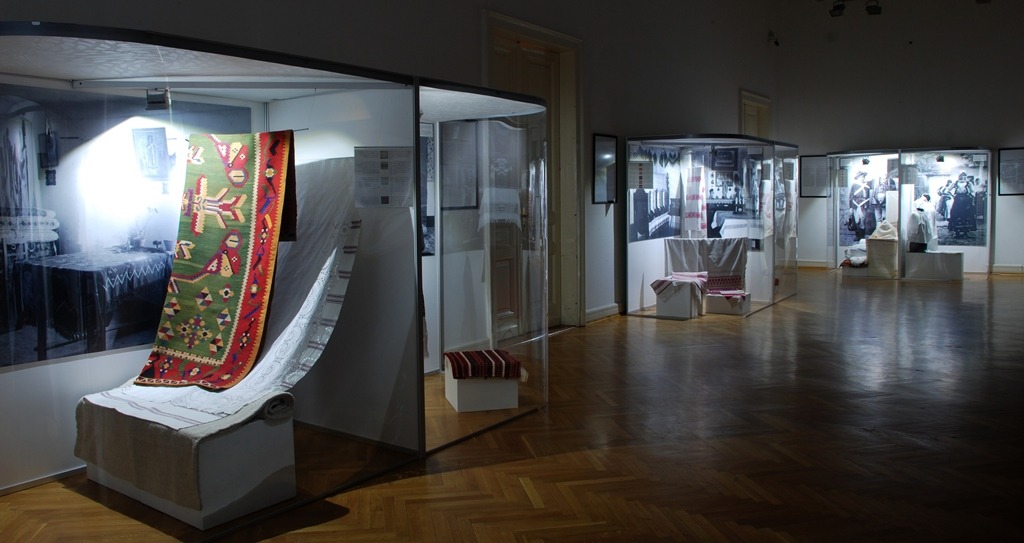
Multiethnic Vojvodina textile traditions – Thematic exhibition, my farewell from active service at the Museum of Vojvodina in Novi Sad, 2014. It was both a romantic memory and a material document of ancient folk life. 12 thematic scenes are associated with the former everyday life of the local people. Archival photographs as backdrops to the showcases gave each presented scene a substantive, chronological context.
In our introductory photo, in the foreground, we see a montage of a traditional Serbian bed, in layers. At the bottom is a paillasse, and on top, a kilim with composition of garden with bees and butterflies. Then, festive Hungarian interiors. And at the far right, a wedding custom and festive summer clothing from the beginning of the 20th century!
Inviting wedding guests.
The traditional elements of the inviter’s equipment are: a white cloth tied decoratively for the shirt, an ornate drink flask, and a decoratively woven bag for carrying gifts. After greeting the hosts, the inviter announces who is getting married, when, and where the wedding guests are gathering, and gives a flask to toast the newlyweds’ happiness. The groom’s close relatives give him a shirt, and the others tie a towel to the flask.
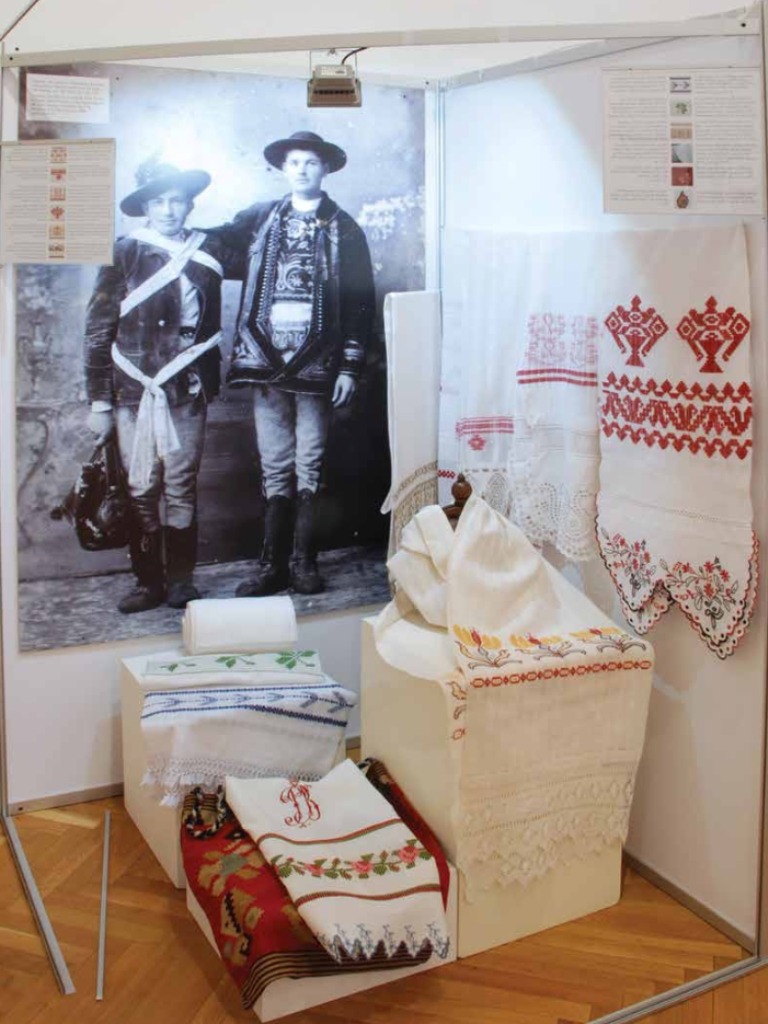
A photograph of a groom with his fellow from Pavliš, Banat, illustrates the custom. Shot in Vršac in the early 20th century.
On the stand, left, is a shirt, an uncut rolled linen, a traditional gift from the bride to the groom, Veliki Gaj; then a towel to tie on the father-in-law’s carriage; a wedding towel with roses, and a bag. All with woven patterns.
Right, on the cube is a wedding flask from Čurug, 1850, wrapped in a towel from Zemun; a towel from Kuzmin, woven with gold, just hanging in the corner; and laterally, wedding towels, from left to the right, from Kovilj, woven in 1900, Zrenjanin, then Kupinovo, 1895, and as a highlight, from Laćarak, 1911.
Festive summer clothing, a female blouse, and a male shirt
In Multiethnic Vojvodina textile traditions – Since the late 19th century, the two-piece white costume has been the basis of summer clothing in Vojvodina. The exhibited samples illustrate the fineness of domestic linen and the hand-woven ornamentation (thick cotton yarns combined with the finest cotton). And the men’s shirt is a model of European cut. A special festive feature of this clothing variety is the combination of elements from industrial cloth (collar, cuffs, and chest).
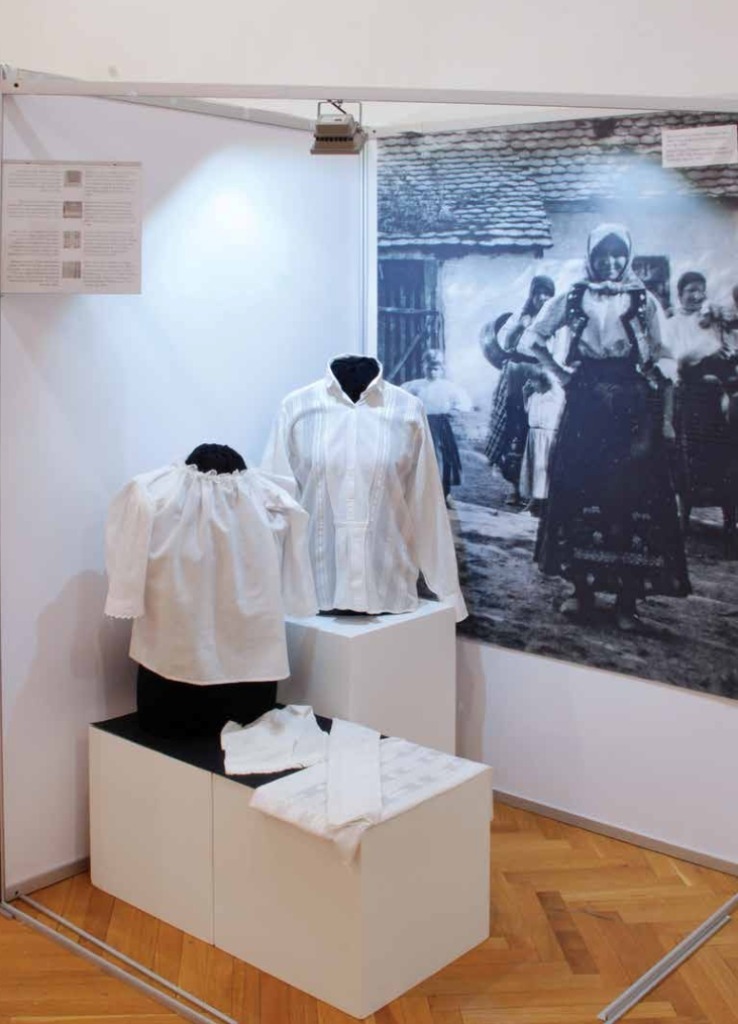
The shot of Nikola Zega, Peasant Woman, taken on a summer day in 1906 in Laćarak, Srem, shows variations of the blouses from grandmother to granddaughter. Displayed left, a woman’s blouse, Central European model, but still preserves archaic Pannonian elements. While a man’s shirt is of a fashionable European cut, made of domestic cotton cloth with thick warp stripes.
The blouse was once woven by Katica Ilić in Žabalj, her dowry in 1876. The sleeves are thin cotton with inlaid patterns of additional weft. An additional pair of sleeves below is of the same origin and features, but with a different pattern. A pair of sleeves by a Romanian woman from Lokve, the oldest Thracian-Dacian cut, but the decorative weaving technique follows local fashion from the end of the 19th century.
Multiethnic Vojvodina textile traditions – Fastening two aprons among Romanian women in the Banat region
The women’s costumes of the Balkan hills contain traces of the old Balkan type of belting, front and back aprons over a long linen shirt. Romanian women in Banat cherished a slightly later stage of this type of belting. The front apron, from two woven halves, is usually wide enough to reach upon a much narrower back apron on the woman’s back. A wide woven belt is over the lap, then back and front aprons. On top, all set, tightened with a narrow belt.
The decorative techniques in weaving aprons alternated over time. Hence, old types in the 19th century had multicoloured stripes. Then, multicoloured twill patterns followed. The 20th century saw the development of finger-picking floral ornamentation. All the way to covering the entire surface with combinations of floral and geometric ornamentation in vivid colours of wool, cotton, and silk.
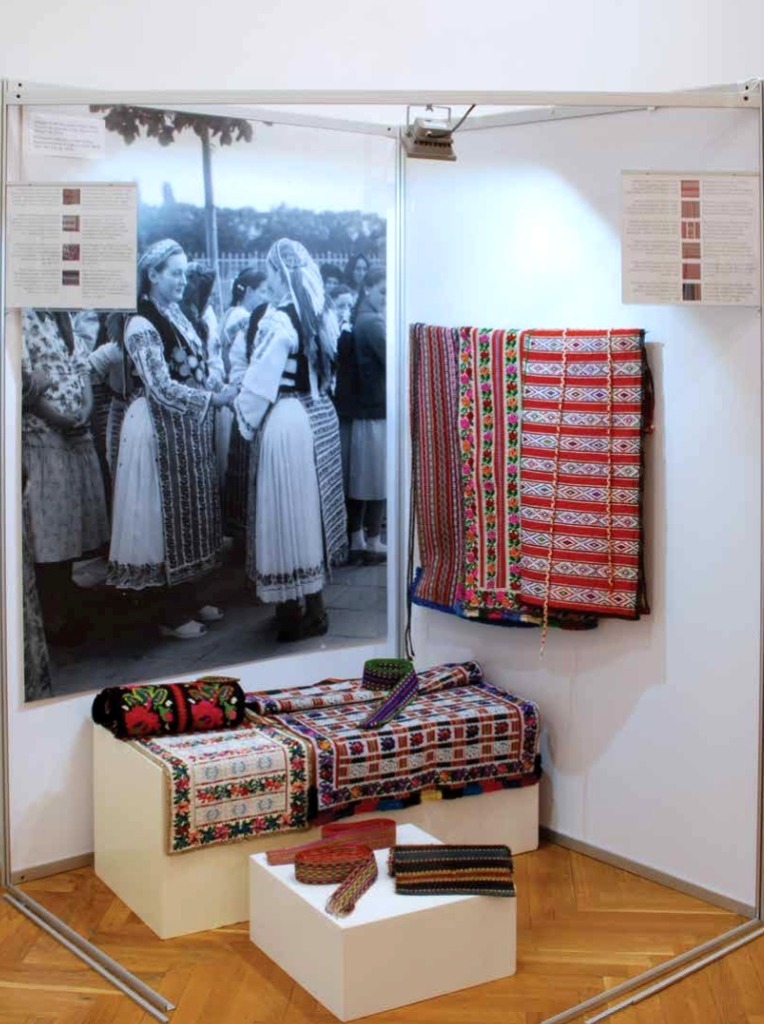
Photo by Mirjana Ilić-Maluckov, Young
women, Romanians at the dance, Uzdin, Banat,
1961. illustrates a type of fastening of two aprons as a living tradition among Banat Romanian women in the mid-20th century.
Displayed below the photos is the traditional set
of two aprons and two woven belts: A wide tapestry woven belt with roses, from Seleuš, back apron, Alibunar, front apron, Uzdin, and the belt made in Vršac. Although they all originate from different locales, they all belong to the same garment style in Romanian clothing. Down, in front, three copies of belts, as well as aprons, and on the side up, are variants of decoration.
Wrapping foot wraps
The oldest form of textile footwear, as we know today, is a pair of uncut, uncoloured fabric for wrapping feet when wearing traditional leather peasant shoes with belts. In winter, made of wool, and in summer, of hemp, a thick, densely woven fabric in four threads. In addition to this original simple form, used in everyday life, folk people have preserved a kind of festive foot wraps. As developed from the soldier’s uniform during the Military Frontier, they were characterized by numerous shades of red. Thus, in the area of Sremska Mitrovica, red wraps with yellow and green stripes. Or around Vršac, also red, with a certain arrangement of colors and patterns.
So, until the 1960s, some elderly men in Romanian villages retained the traditional footwear they had worn since childhood.
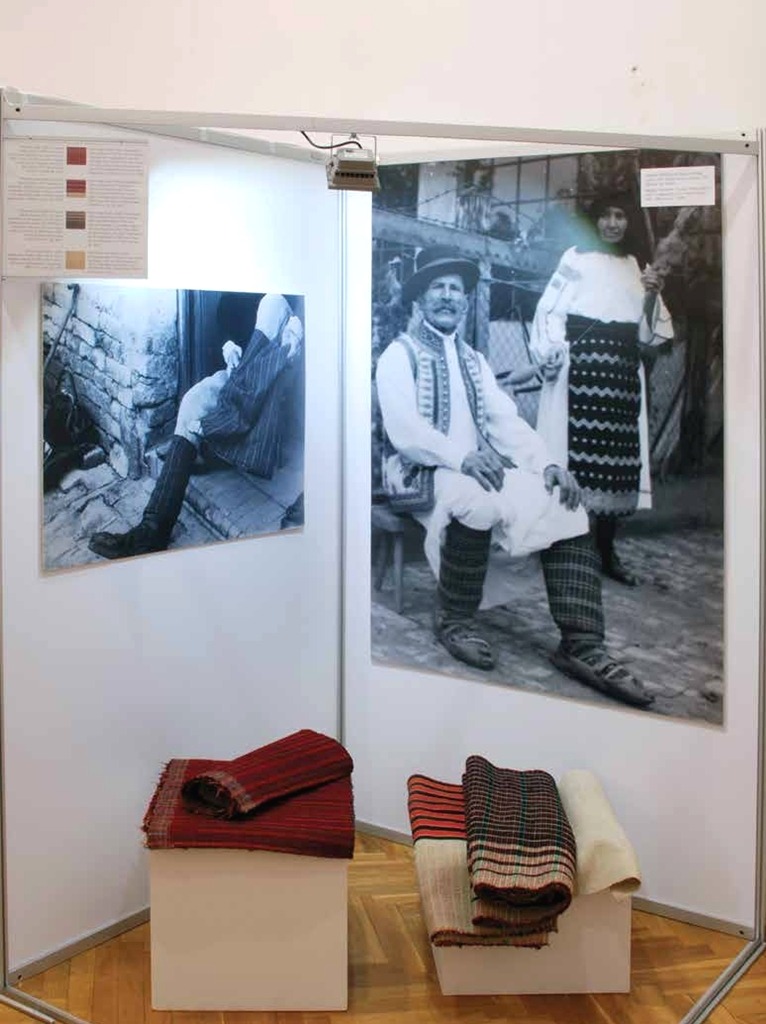
On the left, Mirjana Malukov’s photograph, Caruga Petru, born in 1895, wrapping his feet, Lokve, 1967. On the left cube, features a pair in this photograph. The right photo, by Jozef Rojzval, shows Todor Mojsa in traditional peasant footwear and foot wraps, Ečka, Banat, 1952. On the right cube are two examples among numerous possible decorative color combinations. One from Uzdin, 1915, another from Torak, 1910, and finally, a featureless sample, from Zrenjanin, of uncolored wool, 1953, at a time when they were no longer worn.
Traditional man’s white costume made of puckered fabric
The white men’s costume made of puckered fabrics has been recorded in the same form since the 1870s. And later enriched with gold embroidery, served primarily as ritual clothing. An everyday version of this cut, a straight piece joined together from 3 lengths of cloth without decoration, survived longer in the summer clothing of elderly people.
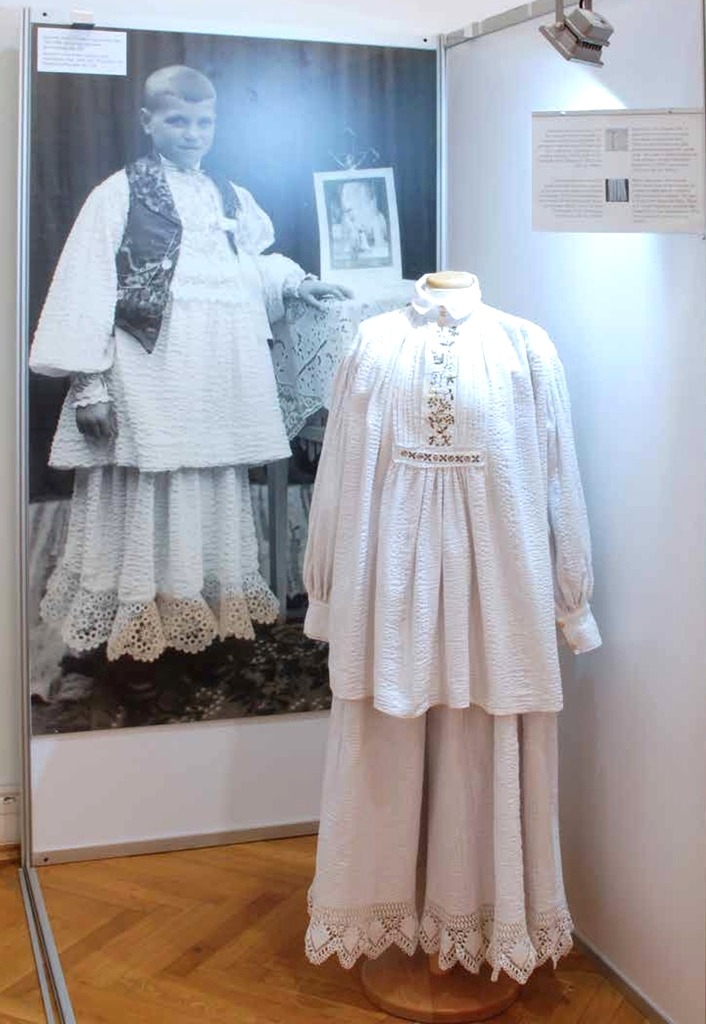
Exhibited men’s festive costume kit of the Šokac ethnic group, from Bač, at the beginning of the 20th century, perfectly matches the boy’s communion clothes in the photograph by an unknown author, Bač, 1943. Both sets of clothes represent a type of Pannonian white linen clothing (shirt and pants).
As in all Pannonian costumes, both are richly pleated. Usually, 4 to 6 lengths, the exhibited specimen consists of 5 lengths. However, the fabric is specific. It is a kind of homemade cotton cloth, locally known as puckered fabric. Warp stripes with relief texture derived using a complex procedure with two warp shafts.
Women’s aprons of the Bunjevac ethnicity group
A colorful woolen apron revived the pure whiteness of the costume with long, wide skirts and blouses with monochrome woven ornaments. The offer of various factory linens, fabrics and silks, at the end of the 19th century, implied the abandonment of home weaving and antique costumes. So the apron survived, as the only element of Dinaric origin, along with the formation of the Bunjevac variant of bourgeois costume. Woven as a single piece of wool or cotton, in stripes in combinations of two or more colors, with tiny shuttle patterns. For younger women, aprons were predominantly light colors, but more often darker, because, as is the rule with archaisms in clothing, only older women wore them.
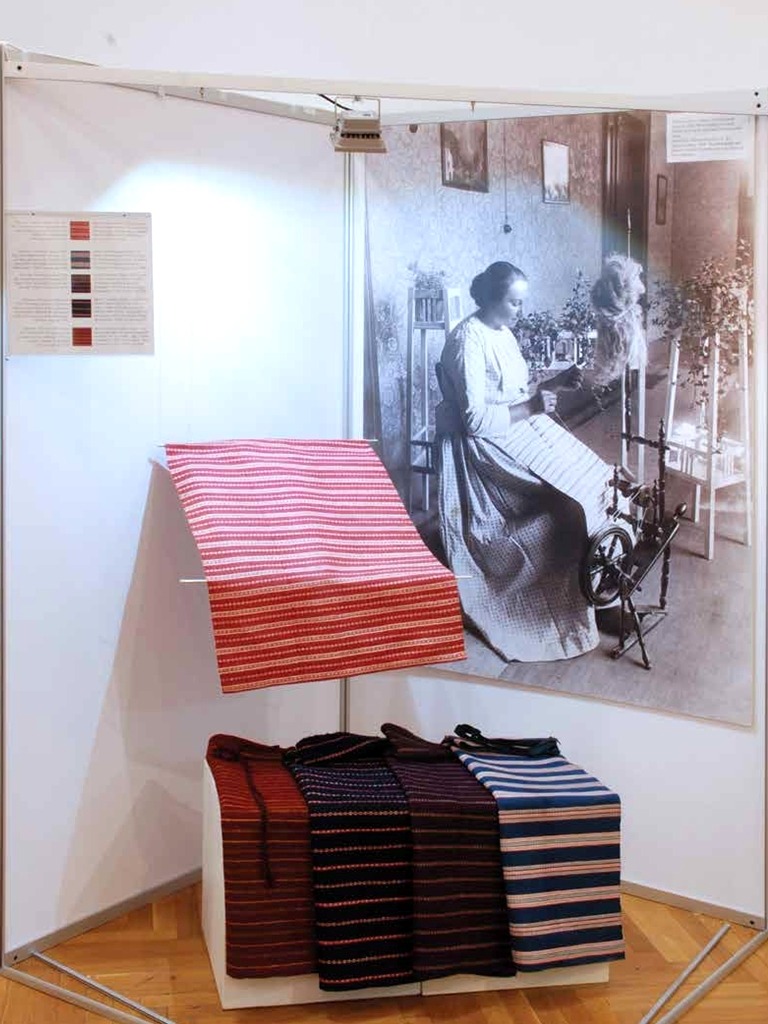
The photograph by the anonymous author, Spinner, Manda Skenderović Lešina, taken in 1920 from the collection of Nestika Skenderović – Leša, provides an excellent visual context for a series of examples of woven wool aprons of Dinaric origin among Bunjevac women in Bačka. Since the apron was part of everyday costume, such visual documents about its function are rare, as are the intimate genre-photographs themselves.
The apron from Bajmok, of cotton, weft rib weaving technique, according to its displayed position, relates to a similar one in the summer clothing combination in the photograph. And below it, four examples vary the same weave type: from Subotica, 1890, and three from Tavankut, all of the same origin, woven in 1910.
Multiethnic Vojvodina textile traditions – Ruthenian weaving
Multiethnic Vojvodina textile traditions – With their immigration in the 18th century, the Ruthenians also brought the culture of linen and hemp textiles, and continued to develop weaving not only in women’s home weaving, but also as a craft. Women were weaving fine linen fabric and decorating it with white or multicoloured embroidery. On the other hand, in the weaving handicraft, technical standards led to harmonizing forms and quality, with limitations of free personal expression. Therefore, nowadays, Ruthenians have a particular emotional attachment to the current funds of old, original weavings. A type of dark red tablecloth with thin multi-coloured stripes, particularly valued for family heritage and a symbol of Ruthenian identity.
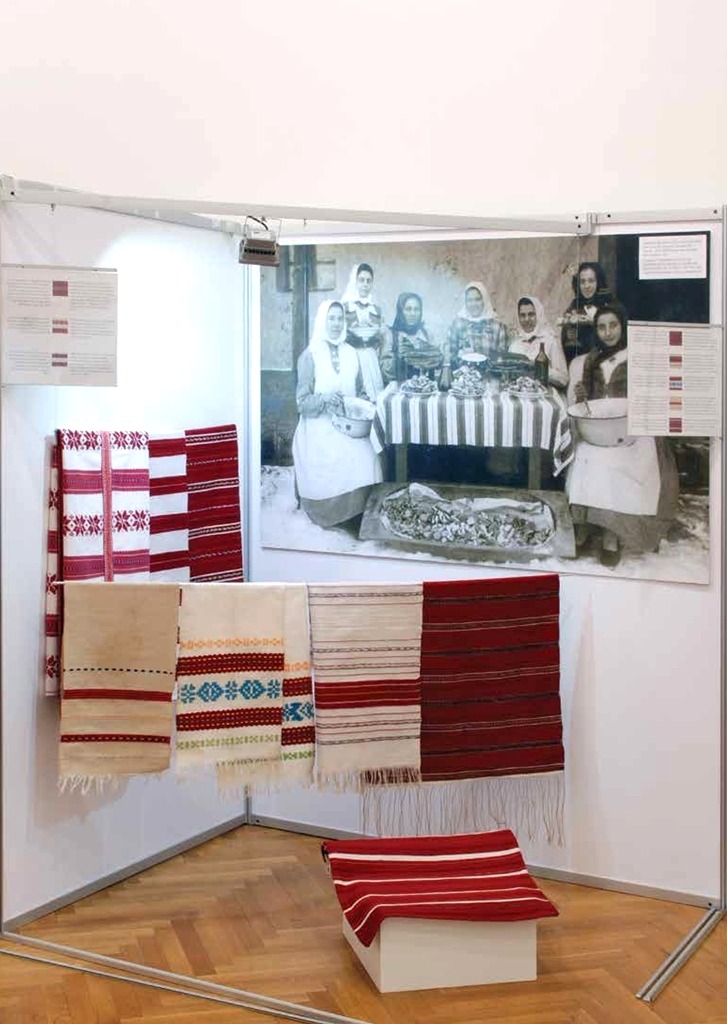
Here, the selection of characteristic interior textiles represents a typical Ruthenian weaving tradition. On the left, next to the photograph, is a red tablecloth from Đurđevo, 1904; and next to it are two, both from Kucura. In the midst is a model, like in a photograph by an unknown author, taken in 1949. in Bikić Do, Srem. The photograph by an unknown author features a Ruthenian family gathering together for a mushroom harvest.
Below, in the foreground, we can see towels: from right to left, from Ruski Krstur, 1900, then from Kucura (but the work of a Ruthenian weaver from Ruski Krstur), 1908, a bread towel from Kucura, 1914. And on a pedestal, below, is a pillowcase from Ruski Krstur, woven in 1890.
Weaving among the Hungarians
Multiethnic Vojvodina textile traditions regarding Hungarians in Vojvodina primarily stem from the development of the craft of weaving. Although masters kept their weaving patterns secret, their apprentices spread them, thereby reaching women in the villages. Additionally, their centuries of exchange of experiences with the Slavs led to the development of distinct weaving cultures among neighbours. Today, the heritage of projects related to the revival of the local Austro-Hungarian textile industry is considered a form of traditional weaving among Hungarians.
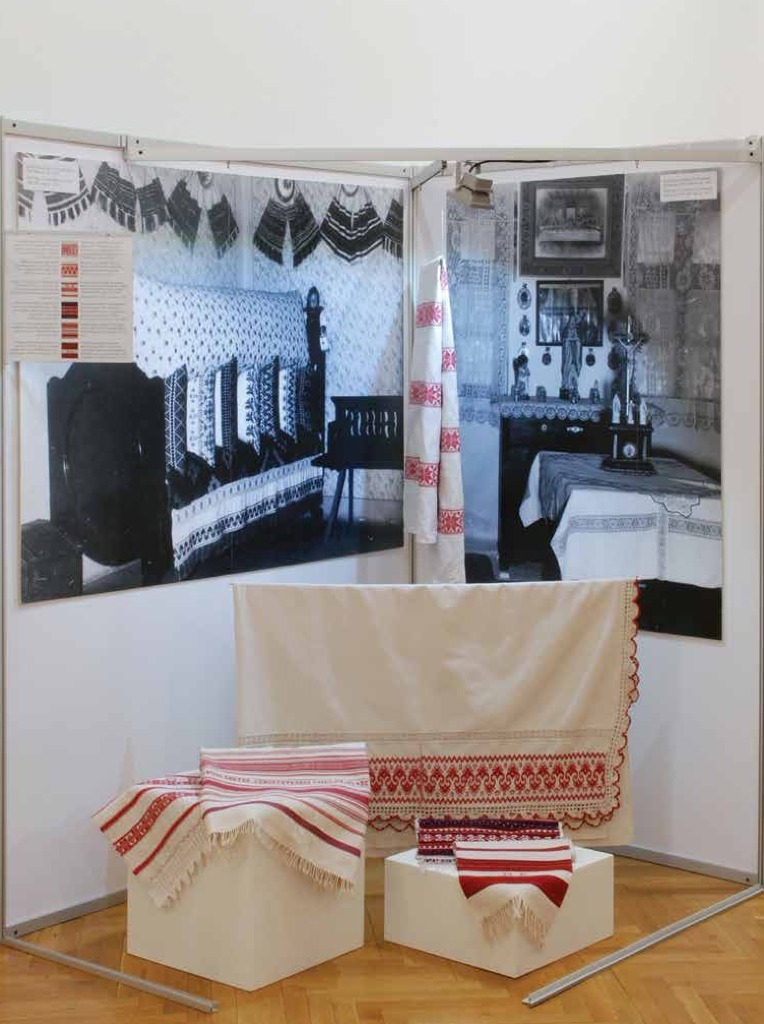
A few elements of interior textiles represent archaisms in the textile culture of Hungarians. We can see them in the photographs of the enteriers, shot by Julija Pap, left, in Vojlovica, 1960. and right, in Doroslovo, 1959. In the corner, a tablecloth from the house where the photo was taken, woven in 1905, as well as the bed sheet from Vojlovica, woven in 1910. Here, complicated weaves are brocaded, after the complex preparation of the warp, according to the pattern in a predetermined sequence.
From left to right, on the pedestals are towels from Doroslovo, 1900, Debeljača, 1864, a further decorative towel from Vojlovica, 1890, and a towel from Doroslovo, actually a gift at the Ruthenian wedding in 1900.
Slovakian weaving traditions
Textile traditions are still alive among the older generations of Slovak women in Vojvodina. They are always happy to show old photos with the distaff, or the dowry, as an intimate confirmation of its former value. Thus, the interior of the painted wardrobe, once owned by Mara Zvarec from 1922, in the ethno-room in Gložan near Novi Sad, reveals perfectly maintained woven tablecloths, towels, bedding, linen supplies, and a selection of creativity from generations. Here, weaver Zuzana Pažitnajova also draws attention to a hundred-year-old grandmother’s tablecloth, woven with the best cotton. And at the end, she makes a deeply emotional point … I still weave today, and I don’t know if anyone else does this …
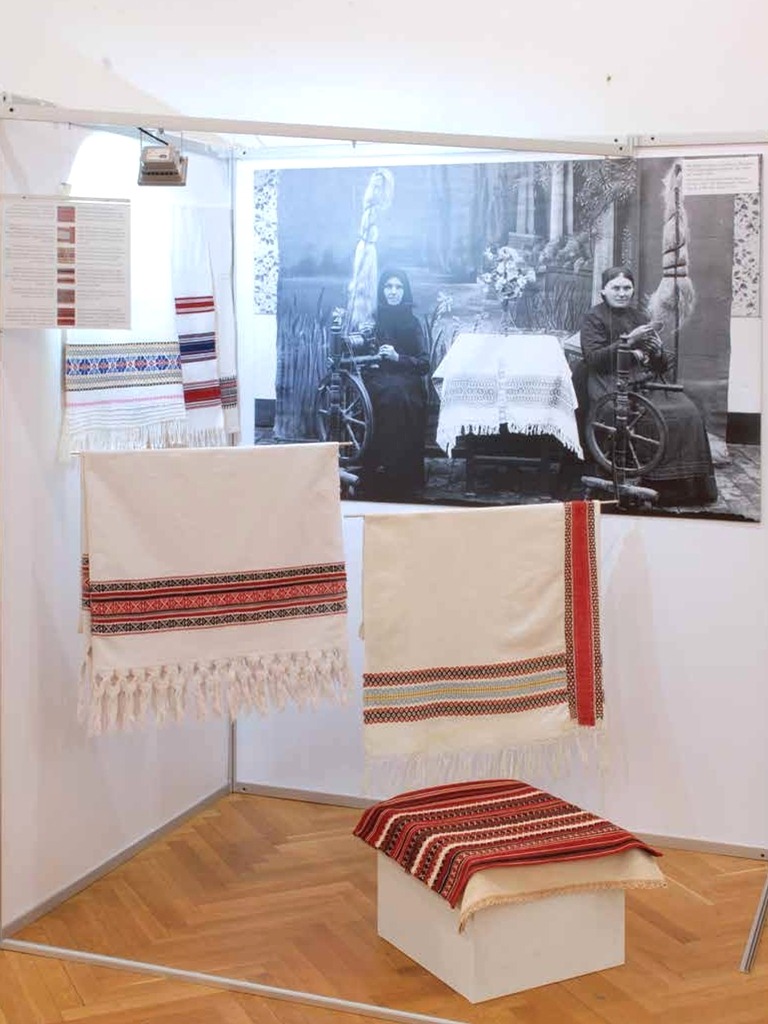
The photo, Slovakian women, Spinners, from Pivnice, Bačka region, 1933, by Jan Cibula, expresses the role of the distaff in a woman’s life, and the scenography with a traditional tablecloth, the great importance of the weaving tradition among Slovaks in Vojvodina.
In front of the photo are two festive tablecloths, left from Stara Pazova, 1910, and right from Kovačica, 1900; on the panel left are towels, from Padina, 1920, Selenča, 1900, and Bingula, woven in 1912, and below, on the pedestal, the pillowcase from Selenča, woven in 1890. This museum selection offers insight into the Slovak folk style popular in the late 19th and early 20th centuries.
Multiethnic Vojvodina textile traditions – Festive bed linen
Multiethnic Vojvodina textile traditions – the development of architecture, housing, and coexistence in a multi-ethnic environment caused the uniformity of the interior of the Pannonian house. The bed in a clean or ceremonial room is a prominent element of the most festive interiors in the Pannonian region. The parallel arrangement of beds is against opposite walls, while the table in the middle can be found in old houses even today. The design of decorative textiles best expresses the aesthetic character of different ethnic communities. This example of festive bedclothes among the Serbs in the Novi Sad area, through basic elements of soft bed inventory, illustrates the development stages and forms of traditional woven bedlinen.
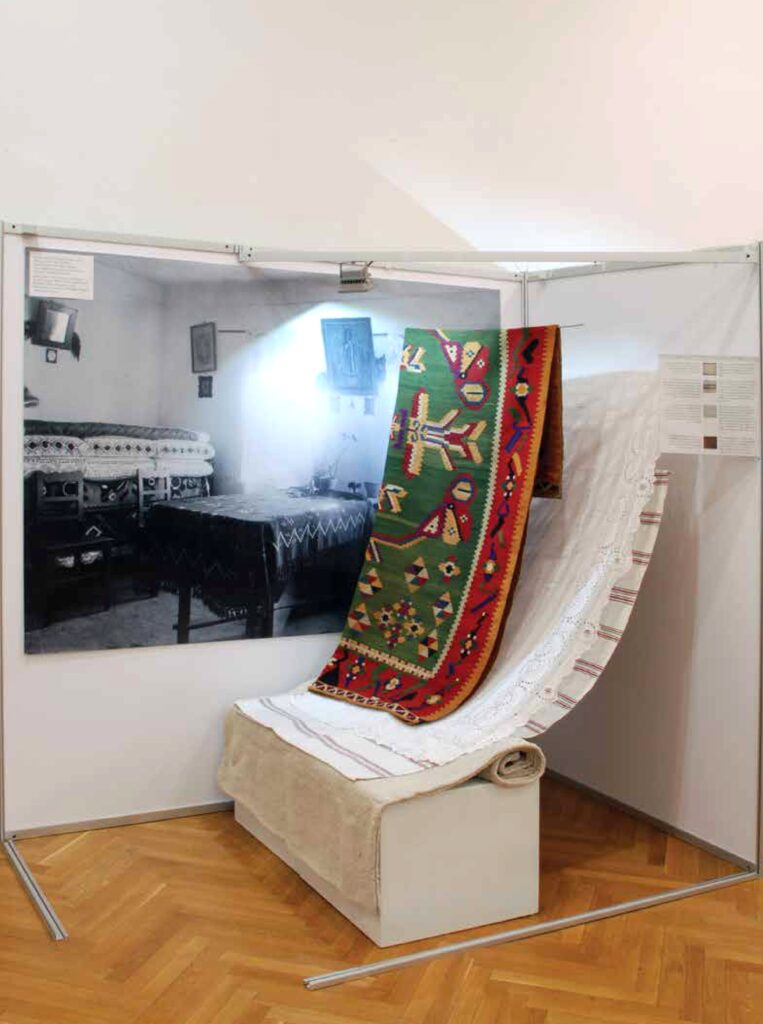
In the background is a photograph by Janos Janko, Interior of a Serbian House, in Crepaja, 1894. This is a rare document of the appearance of an authentic ceremonial housing in the 19th century.
Lower layers are the oldest forms, first a paillasse, a mattress filled with straw; then a simple lower sheet; on top of the bed are visible luxury pieces, a festive cotton sheet from the finest cotton, with lavish white embroidery, and finally a kilim with a decorative composition of bees and butterflies.
An awning mosquito net – bed protection in the open
Exploring Multiethnic Vojvodina textile traditions, I’ve found very few photos of old awning mosquito nets. But in people’s memories throughout Vojvodina, there are still romantic stories about them. The mosquito net was a curtain over the bed in the porch, where the head of the house slept during the summer. Believing in ritual protective power, temporarily spread a net over the bed in the mother`s room with the newborn. In order to hide from the evil eye’s spell. But on the other hand, a child must not be alone in, because someone might replace it with another.
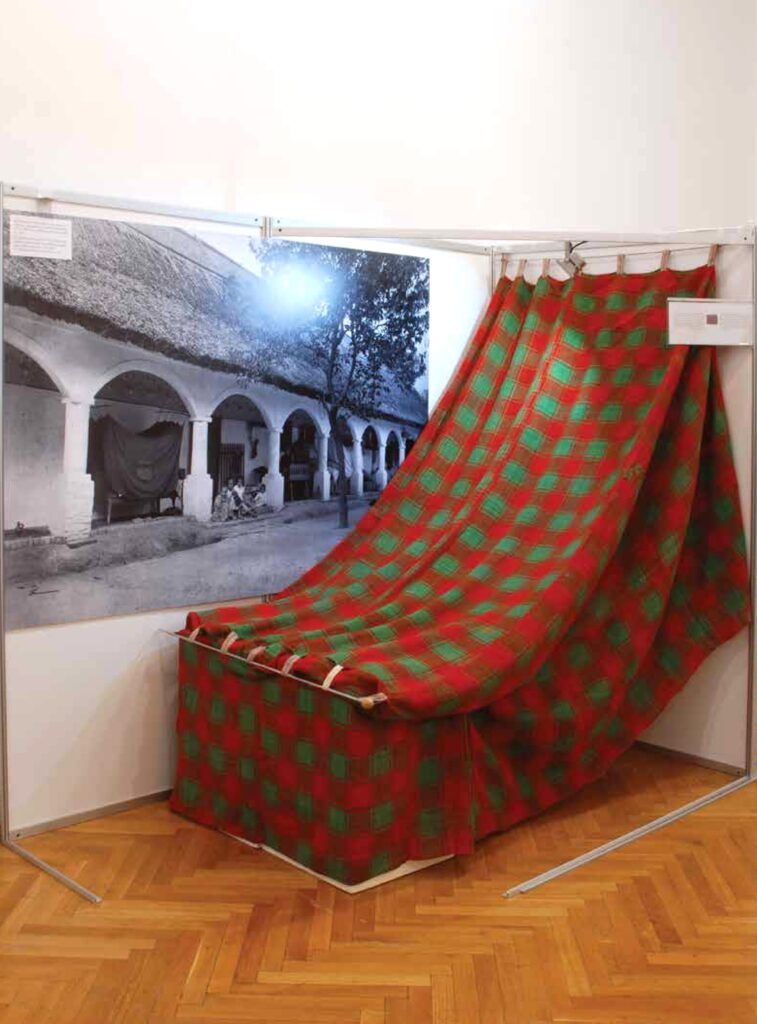
The exterior in the photograph by Dr. Radivoje Simonović, Porch of the peasant house, Bački Monoštor, taken in 1920, is the basis for a credible functional simulation of the exhibited object. This museum’s item, a mosquito net woven in 1915, in the house of Marić in the village of Kać, Bačka.
Made from finely spun, thin wool, in at least two colors. Arranging both warp and weft on stripes, the weaver created a large check pattern. Such a thin, airy weave enables good ventilation and protects against mosquitoes and flies.
Multiethnic Vojvodina textile traditions – Bedspread with tufts of wool
Multiethnic Vojvodina textile traditions – In all Slavic languages, there are traces of this type of textile in its original form, of white, undyed wool. The archaic textile form of the cloak, fringed with woolen yarn, had many functions in folk life. In the Western Balkans, such blankets or cloaks were primarily used to protect people from the cold, rather than for decorative purposes. During livestock movements and cross-country journeys between Lika and the Adriatic coast, the cloak was an indispensable protection outside the house and inside on the bare bed boards, or near the hearth. The typical domestic products of sheep’s wool, among the reasons for its long shelf life. Arriving in Bačka with colonization in the middle of the 20th century as a multi-purpose wearable textile. However, in the new environment, it soon became redundant and turned into a legend.
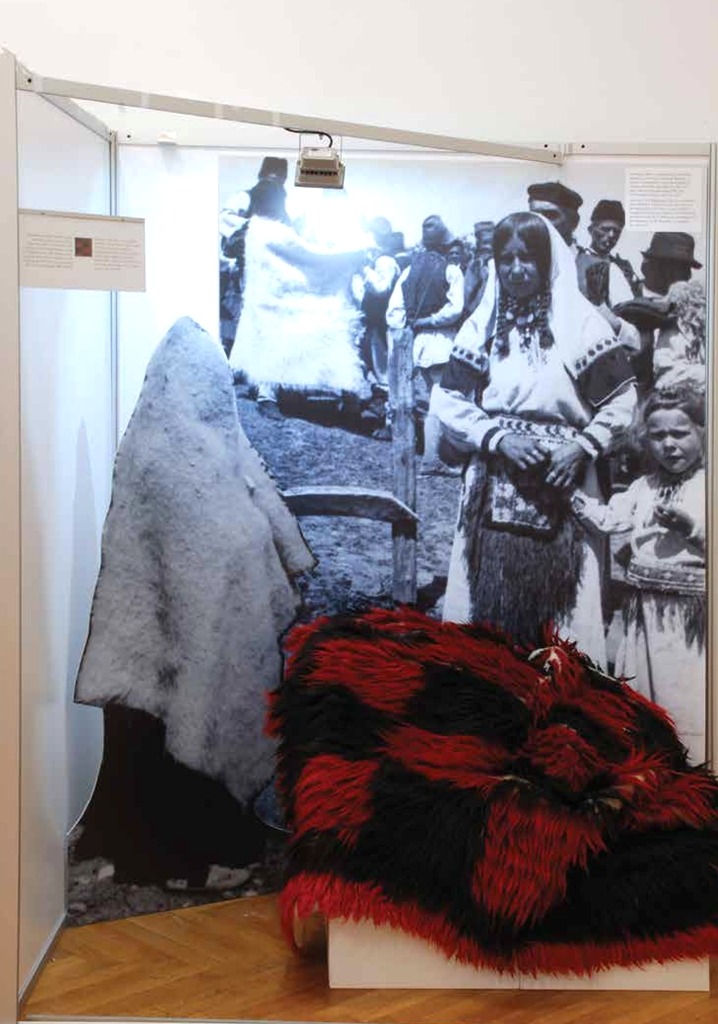
Photographs by unknown authors, taken in the vicinity of Skender Vakuf, show a simple tufted cloak made of white undyed wool. The archival photos show the original form of the textile, while the exhibited museum item, in an installation, represents the form from the very zenith of its development.
Technique is the Ghiordes or Turkish knot in twill, used as a base of undyed wool, with fringes. Shaggy knotted face, a simple two-colour geometric composition (Dnopolje, Donji Lapac, Lika).
And finally,
After words on Multiethnic Vojvodina textile traditions, but until the next time, I am sharing with you a memory of the event, as well as a PDF copy of my Album from 2014.
Sincerely, Branka on Textiles
